

Farming is the foundation of a couple’s mission to build a healthy, supportive community.
By Scott Meyer | Photographs by Rob Cardillo
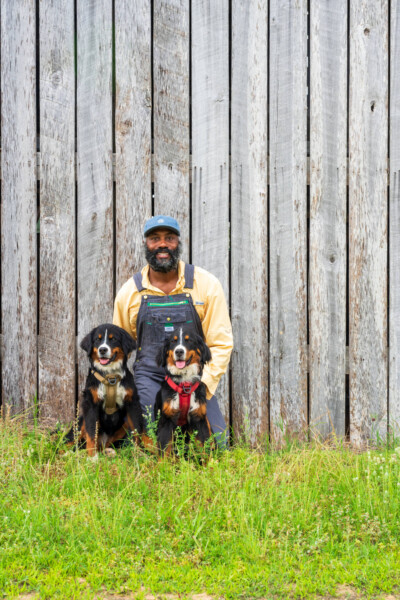
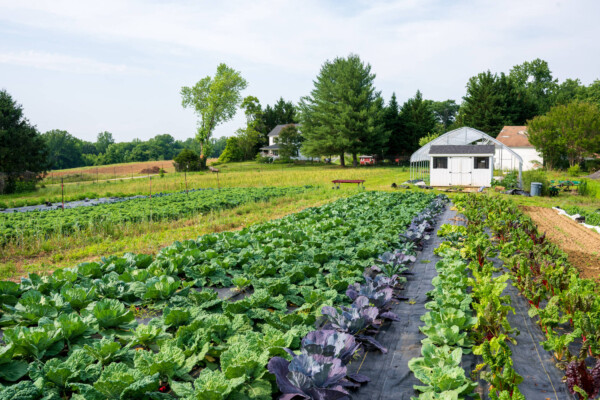
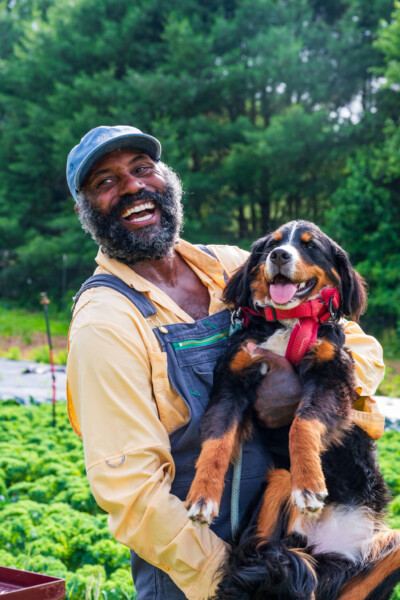
On a steamy, early summer day at Spice Creek Farm in Brandywine, Maryland, the tomato plants are stretching skyward, a sign that they’re ready for support. D’Real Graham, who tends the farm with his life partner Gail Taylor, sets up a wire trellis on which they will train the tomato vines to keep the fruit off the ground. Nearby, peppers and squash are bulking up, too, while rows of kale and chard are at their productive peak. As Graham drives in the posts for the trellis, Ruby and Ivy, their Bernese Mountain dogs, nibble on the leafy greens.
Taylor has been raising food on a 2-acre urban farm in Washington, D.C., for more than 10 years, but 2025 is the couple’s first full growing season on the more expansive, rural site in Brandywine, which is about 25 miles southeast of the city. A former tobacco farm, Spice Creek Farm encompasses 24 acres on which the pair is implementing their ambitious plans to establish a food system that is community based and equitable. “We want to provide good, healthy food to people, especially children, and we want to be part of a community of farmers,” Taylor says. “We are creating a food hub and joining with others to build a Black Agrarian Corridor here in southern Maryland.”
Their progress toward those goals made them finalists for the inaugural U.S. Good Farmer Award, a joint effort by Rodale Institute and the Davines Group to recognize “outstanding farmers making positive environmental and social contributions to agriculture through regenerative organic practices.” The couple is currently working with the Rodale Institute consulting team to help them scale up their operation.
SETTING DOWN ROOTS
Taylor and Graham came to the region and to agriculture from different backgrounds. She spent her teenage years near Albany, New York, and moved to Washington, D.C. after earning a degree in U.S. foreign policy and Latin America from Syracuse University and spending time in Guatemala and Chile. In 2005, she began volunteering at Deep Roots Farm, a 200-acre regenerative organic farm in Upper Marlboro, Maryland (like Spice Creek, in Prince George’s County). The following season, Taylor was hired by Gale Livingstone, proprietor of Deep Roots. “I was looking for a change from policy work and farming felt to me like I was having a positive impact for people,” Taylor says.
Her responsibilities grew, as did her commitment to serving her community with fresh food. But she grew tired of the long commute from the city out to the farm. In 2011, she drafted a business plan for an agricultural operation that began as a backyard CSA (community supported agriculture subscription service) from her home in Washington. “Three people offered me the use of their yards to grow food and I set up a greenhouse in mine to raise seedlings for sale,” Taylor recalls. “I rode my bike to each yard on Thursdays to collect the harvest, which I put on my porch for the six CSA members.”
Taylor was ready to expand and identified an unused two-acre plot near Catholic University that she wanted to transform into an urban farm, but tax laws in the city made it cost-prohibitive to lease for that purpose. “D.C. had no policy for levying property taxes with agriculture exemptions like you find in so many places,” she explains. With pro bono assistance from American University law students, Taylor led the effort to pass the city’s 2014 DC Urban Farming and Food Security Act, which changed the tax law and allowed the city to lease land to growers. Taylor launched Three Part Harmony Farm on the site in 2015, and, by 2024, its 64 3-by-100-foot beds produced 7,000 pounds of fresh food.
Graham was raised in Michigan and pursued a career in education, and he moved to Washington to work for an educational nonprofit. Like Taylor, he started as a volunteer at Deep Roots Farm and his role grew. “I was ready to pivot from office culture to agriculture, but it was hard,” he says. “At first, Farmer Gale only trusted me to weed, but I came to it humbly and was willing to learn.” By the end of his first year there, he was driving the delivery van and managing the Deep Roots’ stand at three weekly farmers markets.
After meeting at Deep Roots, Graham and Taylor began their personal relationship and in 2019 he joined the team at Three Part Harmony Farm. Together, they began looking for a larger space where they could increase production and begin implementing their vision for a food hub. They leased the Brandywine property in 2022 to grow crops to add to the harvest from the city lot. In December 2023, the couple entered into a lease-to-purchase arrangement for the land with support from Dirt Capital Partners, funders of regenerative organic agriculture projects.
STARTER SET
Gail Taylor and D’Real Graham have connected with experienced and beginning growers in southern Maryland who share valuable knowledge and insights with each other. The couple also is getting technical assistance from the Rodale Institute consulting team on preparing their chicken pasture, choosing appropriate equipment, and other needs.
Rodale Institute consultants help beginning and transitioning farmers with just about every aspect of operating a successful organic farm, from soil building, weed management, and crop rotations to navigating the certification process, recordkeeping, and inspection preparation. The consulting team can also help with identifying buyers and markets, accessing financial resources, and networking with other farmers.
To date, the consultants have worked with more than 1,000 farmers in nearly every state in the contiguous United States to help transition more than 45,000 acres to organic production. They are key to helping Rodale Institute work toward its goal of transitioning 1 million acres of farmland to organic. “Each farmer has a main contact they can reach out to with any question,” says Hilaire. “But there is a whole team behind the main consultant, and we all work together to serve the farmer’s needs.”
For more details and to support the effort to increase organic acreage, visit rodaleinstitute.org/consulting.
BUILDING ON HISTORY

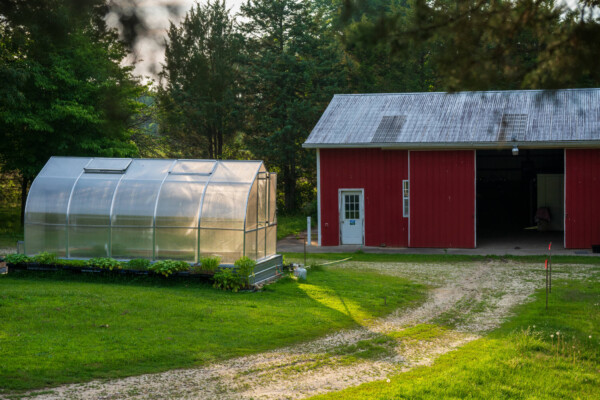
The property came with a brick house by the roadside, a few outbuildings of different ages and styles, and a smaller cabin set near the center of the acreage. The entire parcel had been owned by several generations of the locally-prominent Baden family and the fields were used to raise tobacco, and later corn and soybeans. “I researched the history of this land, and I learned that 110 people had been enslaved here at one time,” Graham says.
The property is bordered on one side by Spice Creek, which runs into the nearby Patuxent River, a tributary to the Chesapeake Bay watershed. The farm shares a lane with several private homes, one of which has converted a horse barn into an indoor pickleball venue. The sloping field that the couple intended to plant first needed remediation before it was suitable for growing regenerative organic crops. The corn and soybean growers had used heavy tractors, which compressed the soil, and conventional methods, including herbicides. “The soil was so degraded that we brought in seven truckloads of compost” in summer 2022, Graham says. “We rented a skid steer, and I spent three days spreading the compost.”
Taylor and Graham then installed deer fencing, and they hand-dug beds, which they planted with their first crops of sweet potatoes, white potatoes, watermelon, eggplant, and tomatillos. They’ve since added more beds using a walk-behind tractor, installed a water line for drip irrigation, set up a wash station for the harvest, and added a small greenhouse where they raised seedlings for themselves and to sell to local farmers and gardeners. “We’re about to plant cotton and cowpeas,” Graham says. “We are growing cotton because we want to learn how to grow it and to restore our community’s relationship to the plant.”
A field on the other side of the brick house is planted with native species that attract pollinators. The couple is preparing to raise chickens on pasture in that field and put their two pups in training, Ruby and Ivy, to work protecting them. “We’ll also have goats to help with clearing fields when needed,” Graham says.
As the farm operation grows, it faces fresh challenges. “When farmers begin to scale up, they need to balance their short-term needs for infrastructure and equipment to keep up with their growth, while staying focused on their long-term plans,” says Kegan Hilaire, Rodale Institute’s small farms and diversified vegetable consultant, who has been advising Taylor and Graham on a variety of topics. “A walk-behind tractor can get you started, for example, but it’s not going to be enough when you’re working 20 acres. You also need simple infrastructure for post-harvest preparation and storage that can handle the volume you’re harvesting now, while you save for a bigger cooler and processing space.”
MOVING AHEAD
Hilaire has provided Taylor and Graham with guidance on accessing grants and other economic resources for projects such as livestock fencing and stream conservation. But 2025 has brought a dramatic reduction in federal support for small-scale, organic farms. “We didn’t bring a lot of capital to this,” Graham says. “We have depended on grants for funding and those cuts have had a big impact on us.”
Like many farmers across the country now, Taylor and Graham are challenged to find reliable labor to help with tending and harvesting the crops. “For many black and brown people, working in agriculture has negative connotations,” Graham notes. In 2025, they will have one worker who is living with them in the brick house. “We are planning to develop the white cabin into a home for us and to keep the brick house for employee housing, which we think will make us more attractive to people who want to do the work.”
While building up Spice Creek Farm, the couple is partnering with other local food producers and forming a new agriculture community in this corner of Maryland. Graham names a half dozen nearby farms with which they share information and resources and discuss topics such as crop rotations. “We think it makes sense to rotate in coordination with each other, so we are serving customers without competing to sell the same products,” Graham says. The social support is important, too. “We like to just sit down to meals together and talk with people who understand our lives.”
Those connections are central to the larger plan for Spice Creek Farm. “We’re reactivating what I did in the city, when I set up a multi-farm CSA” that provided 270 members with a variety of food from 12 different sources,” Taylor explains. “We want to relaunch that idea here, creating important marketing opportunities for other farmers while offering customers the chance to choose to buy from Black farmers, women farmers, and regenerative organic farmers. We believe we can all succeed together.”
For Taylor and Graham, success will include offering workshops that teach consumers about healthy food and restoring the vitality of the land. “We aspire to be land stewards as much as farmers,” Graham says. “We wake up every day with the goals of building the soil and producing food that’s good for people,” Taylor adds. “We want to get to the point where we can nurture the next wave of beginning farmers.”
FARM FACTS
Spice Creek Farm, Brandywine, Maryland
24 acres of land
3 acres (and growing) of vegetable crops
150 current CSA members
48 weeks of food production each year
This piece was originally published in the 2025 Rodale Institute Journal. Get the full issue here.