

Dinesh Panday*, Saurav Das, Said Hamido
*Email: dinesh.panday@rodaleinstitute.org
Highlights
· Organic systems hold yield when the weather fails. Organic maize out-yielded conventional by 31% in the 2016 drought. In 1999, drought followed by Hurricane Floyd cut conventional maize to a fifth of its normal yield; the organic manure system produced 37% more grain.
· Water explains the difference. Organic soils stored 16–25% more water over five years and captured more than twice as much during the 1999 flood. Infiltration rates remain two to three times higher than conventional.
· Carbon accumulates and persists. After 40 years, organic systems held 16 to 26 more tonnes of carbon per hectare than conventional, measured to one meter depth.
· Organic management lowers greenhouse gas emissions. Switzerland’s 42-year DOK trial recorded 40% lower nitrous oxide emissions, and a global review of 19 studies placed organic soils 492 kg CO₂-equivalent per hectare per year below non-organic.
· Pasture is the largest untapped opportunity. Grazing land covers 41% of U.S. farmland. Rotational grazing with diverse cover crops raised soil carbon 13% in three years; grazing without cover crops delivered 4%. System design determines the outcome.
1. Introduction
Agriculture has always been shaped by the weather. What is changing is the magnitude, frequency, and economic consequences of weather-related risks. Rising temperatures, prolonged droughts, extreme rainfall, and increasingly erratic growing seasons are exposing vulnerabilities in agricultural systems worldwide. The World Meteorological Organization (WMO) reported that 2015 – 2026 were the warmest years on record, with global mean temperature approximately 1.43oC above the 1850 -1900 average (WMO, 2026).
Water is the center of this challenge. The OECD’s 2025 Global Drought Outlook estimates that 40% of the world’s land area is experiencing increasingly frequent and severe droughts and that 37% of global land has experienced significant soil-moisture loss since 1980 (OECD, 2025). During severe years, crop yields can decline by as much as 22%. But climate risk does not reach a farm as a global statistic. It reaches the farm through the soil.
Farmers cannot control when rain falls, how long drought persists, or when extreme heat arrives. They can influence what happens when those stresses reach the field: whether rainfall infiltrates or runs off, whether water remains available to roots, whether soil structure withstands intense precipitation, whether nutrients continue to cycle, and how rapidly the system recovers after stress. Soil function is therefore one of agriculture’s strongest defenses against climate instability.
In this article, regenerative organic agriculture refers not simply to organic certification, but to organic production systems intentionally designed to rebuild soil function through diverse rotations, cover crops and continuous living roots, organic nutrient sources, reduced or strategically managed disturbance, and, where appropriate, integration of livestock. These practices influence the biological, physical, and chemical processes that determine how soil captures water, stores carbon (C), cycles nutrients, supports biological activity, and responds to environmental stress. Long-term research provides an opportunity to answer that question.
2. Long-Term Evidence: What Happens When Weather Becomes Stressful?
The Farming Systems Trial at Rodale Institute offers a rare long-term platform for evaluating climate resilience in cropping systems. Since 1981, it has compared conventional and organic grain systems under the same local climate, allowing system performance to be assessed across a wide range of weather conditions, including, over more than four decades, several episodes of substantial drought. Duration matters: resilience differences are invisible in an average year and emerge only when conditions turn adverse.
The clearest evidence comes from Lotter, Seidel, and Liebhardt’s (2003) analysis of the trial’s first two decades. Across five moderate-drought seasons between 1988 and 1998, the organic manure- and legume-based systems significantly out-yielded the conventional system in four of the five years. The fifth year showed no significant difference (Figure 1). The most severe test came in 1999, when a spring-to-summer drought cut the region’s rainfall to a fraction of normal before Hurricane Floyd reversed it into the wettest September on record. Under that whiplash, conventional maize collapsed to a fifth of its long-term average yield; the organic manure system still produced 37% more grain than conventional, and the two organic systems’ soybean yields ran 53–96% ahead of it. A more recent synthesis of the trial’s data, focused on the drought year 2016, reports organic maize yields averaging 31% higher than conventional.
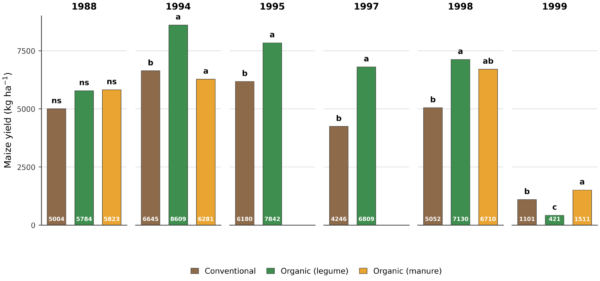
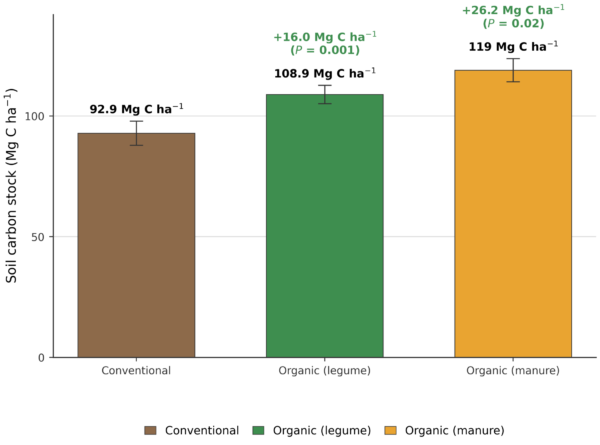
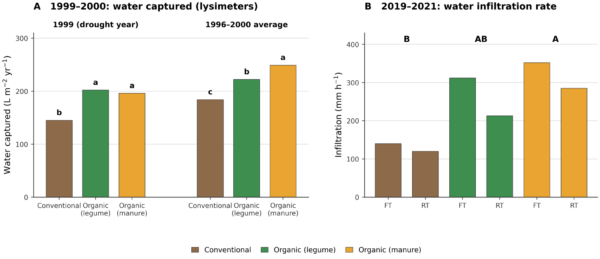
The 1999 season is informative not because the organic systems yielded more, but because of how each system failed or succeeded. The conventional system underperformed both the drought and the subsequent flood, while the organic manure system managed both stresses well. The organic legume system’s maize crop, notably, did fail that year; but the cause was weed competition, not a lack of water-holding capacity. That mechanism is traceable to soil. Drinkwater, Wagoner, and Sarrantonio (1998), working with the trial’s first 15 years of data, showed that soil C increased significantly in both organic systems; by roughly a third in the manure-based system and 15% in the legume-based system, while the conventional system showed no significant change. That C advantage persists across the full soil profile today (Figure 2). Lotter et al. (2003) later linked this directly to drought performance: soils under organic management captured roughly 16–25% more water over a five-year period, held 7–13% higher water content in the crop root zone, and captured more than twice as much water as the conventional system during the September 1999 deluge.
A recent 40-year synthesis of the trial demonstrates that these effects are not merely remnants of the trial in early decades but remain evident after four decades of continuous management (Das et al., 2026 Under Review; Das, Hamido, & Panday, 2026). Measurements collected between 2019 and 2021 showed that water infiltration rates in the organic systems were two to three times greater than those in conventionally tilled plots, accompanied by significantly higher soil microbial biomass and soil organic matter (Figure 3). Thus, the mechanisms first documented in 1998 remain clearly detectable in the same soils more than a quarter-century later, demonstrating the persistence and long-term resilience of soil improvements associated with organic management.
3. Extending the Pattern Beyond One Long-Term Trial
The Farming Systems Trial provides uniquely long-term evidence, but it represents one location, soil environment, and set of crop rotations. The broader question is whether similar soil processes appear under different climates, production systems, and landscapes. Research conducted by Rodale Institute between 2022 and 2026 across farms in Missouri, Arkansas, and Tennessee provides an opportunity to examine that question in warmer environments and in systems incorporating crops, perennial vegetation, and livestock (Hamido et al., 2025; Hamido et al., 2026).
Across these studies, combinations of regenerative practices generally produced greater changes than individual practices used alone. Soil organic C increased by approximately 28% in perennial orchard systems, 13% where rotational grazing was integrated with cover crops, 7% under cover crops alone, and 4% under grazing without cover crops. Increased soil C was accompanied by changes in microbial biomass, nutrient cycling, aggregation, infiltration, and other indicators of soil function. These responses reinforce an important principle: climate resilience is produced by interacting components of the farming system rather than by any single practice.
4. Grazing, Living Cover, and Climate Resilience
Grazing lands represent an especially important part of the climate-resilience discussion because they occupy a substantial portion of agricultural landscapes and can maintain living vegetation for much of the year. A 1,620-hectare regenerative organic ranch studied in Missouri provided an opportunity to separate the effects of grazing from those of continuous plant cover. Rotational grazing combined with diverse cover crops increased soil organic C by approximately 13% over three years, compared with approximately 4% under grazing on native grasses without cover crops. Cover crops alone increased soil C by approximately 7% (Hamido et al., 2025; Hamido et al., 2026). The difference is important because grazing itself is not necessarily regenerative. Its effects depend on how animals, plants, and recovery periods are managed.
Well-designed grazing systems can maintain living roots and protective soil cover, return organic material to the soil, stimulate plant regrowth, and support diverse rooting patterns. Greater aggregation and continuous cover can improve rainfall infiltration and reduce the amount of
water lost as runoff, while deeper and more diverse root systems can help plants access moisture from a larger volume of soil during dry periods. Adequate recovery is equally important. Plants need sufficient time after grazing to rebuild leaf area and root reserves. Grazing intensity, stocking rate, timing, recovery period, forage diversity, soil type, and rainfall therefore determine whether livestock improves soil function or contributes to degradation.
The climate strategy is not simply to graze more. It is to design grazing around living cover, active roots, plant diversity, and adequate recovery. This also helps explain why combinations of practices can outperform individual interventions. Livestock can influence nutrient cycling and plant growth, but the climate-resilience benefit becomes much stronger when grazing is integrated with a productive and diverse plant community.
5. Evidence from Other Long-Term Trials
The soil function and processes recorded at Rodale Institute are not unique to one region or one rotation. The DOK trial in Therwil, Switzerland, established in 1978 and the world’s longest-running side-by-side comparison of biodynamic, bio-organic, and conventional cropping systems, provides an independent multi-decade test under different soils, a different climate, and a seven-year rotation. After 42 years of continuous management, the organic and biodynamic systems supported significantly greater soil biological activity and retained more soil organic C relative to the conventional systems (Krause et al., 2022).
The climate benefit at DOK is not limited to soil C only. Direct flux measurements across a full grass-clover–silage maize–green manure sequence recorded a 40.2% reduction in area-scaled nitrous oxide (N₂O) emissions under organic compared with non-organic management (Skinner et al., 2019). Gattinger et al. (2012), analyzing 74 paired comparisons of organic and non-organic systems, found significantly higher soil organic C under organic management: 0.18% higher in SOC concentration, 3.50 Mg C per hectare higher in topsoil stocks, and a C sequestration rate 0.45 Mg C ha⁻¹ yr⁻¹ greater than under non-organic management. Skinner et al. (2014), reviewing 19 field-based comparisons worldwide, reported that area-scaled N₂O emissions from organically managed soils averaged 492 kg CO₂-equivalent per hectare per year lower than from non-organic soils, alongside greater uptake of atmospheric methane.
6. Integrating Livestock: More Than Adding Grazing
Integrating livestock back into cropping systems may provide another pathway for building climate resilience, particularly when grazing is combined with cover crops, perennial forage phases, and adequate plant recovery. Rodale Institute’s Midwest Organic Center is examining this directly through its Diverse Systems Trial, which integrates cattle into diversified corn–soybean rotations and compares the effects of grazing animals with those of composted manure alone. The trial is designed to determine whether livestock contribute benefits beyond nutrient addition, including changes in soil health, crop diversity, and system function.
Earlier collaborative research involving Rodale Institute provides evidence for this mechanism. In a four-year organic crop–livestock experiment conducted in Pennsylvania and Minnesota, rotational grazing of cover crops increased soil C, microbial enzyme activity, and nutrient cycling. Cover crops also helped buffer potential negative effects associated with grazing, demonstrating that livestock integration works as part of a broader cropping system rather than as an isolated practice.
Longer-term studies show that these changes can extend to the soil properties most important for climate adaptation. In eastern South Dakota, integrated crop–livestock fields managed for more than 30 years contained 20–26% more soil organic carbon and had 18–37% lower bulk density than comparable corn–soybean fields without cover crops or grazing (Dhaliwal and Kumar, 2021). They also had greater water retention, porosity, and infiltration. These differences were not yet evident in a three-year integrated system, suggesting that many of the hydrological benefits of livestock integration develop gradually as soil structure and organic matter accumulate.
Long-term experiments elsewhere provide direct evidence of climate resilience. In an 18-year soybean–pasture system, light-to-moderate grazing increased soil C relative to an ungrazed treatment and improved resistance to climatic extremes (Delandmeter et al. 2024). Modeling based on the same experiment showed that integrated systems were generally more resilient to both unusually wet and dry conditions. More recent regional modeling likewise found greater production stability under climate change where temporary pastures and livestock were integrated into crop rotations.
The key is management. Grazing intensity, stocking rate, forage diversity, residue cover, soil conditions, and recovery time determine whether livestock improve or degrade soil function. Excessive grazing can compact soil, remove protective vegetation, reduce soil moisture, and reverse carbon gains. Well-managed integration, in contrast, can keep living roots in the system longer, recycle nutrients through manure and urine, increase plant and root inputs, and create perennial phases within annual crop rotations.
7. What This Means for Farmers, Communities, and the Climate
Across cropping and pasture systems, the evidence points in the same direction: soils built through practices such as cover crops, compost and manure inputs, diverse rotations, and reduced disturbance can store more carbon, improve water management, and help maintain productivity during drought, heavy rainfall, and other climate extremes. For farmers, these benefits translate directly into resilience. Healthy soil can absorb and retain more water during intense rainfall, provide crops with greater access to stored moisture during dry periods, support nutrient cycling, and reduce vulnerability to increasingly variable growing conditions.
Long-term studies also show that organic systems can maintain competitive yields and, in some cases, perform especially well during climatic stress. The benefits extend beyond the field. Practices that keep nutrients and soil in place can reduce nitrate, phosphorus, sediment, and pesticide losses to waterways, protecting drinking water and downstream ecosystems. Reduced reliance on synthetic pesticides can also lower potential exposure for farmworkers, farm families, and surrounding communities. Farmers do not have to change the entire operation at once.
Hence, a practical starting point is to establish a soil health baseline, introduce practices such as cover crops, diversified rotations, organic amendments, or reduced disturbance where appropriate, and track changes over time. Records of soil conditions, management, yields, and weather can help identify which practices provide the greatest resilience under local conditions. As climate extremes become more frequent, building and protecting healthy soil becomes an increasingly important part of agricultural risk management.
References
Das, S., Hamido, S., & Panday, D. (2026). Soil Health in Practice: Principles, Proof, and the Path Forward. Rodale Institute. rodaleinstitute.org/science/articles/soil-health-in-practice-principles-proof-and-the-path-forward/
Das, S., et al. (2026). Deep Soil Carbon. [Under review]. SOIL.
Delandmeter, M., de Faccio Carvalho, P. C., Bremm, C., dos Santos Cargnelutti, C., Bindelle, J., & Dumont, B. (2024). Integrated crop and livestock systems increase both climate change adaptation and mitigation capacities. Science of the total environment, 912, 169061.
Dhaliwal, J. K., & Kumar, S. (2021). Hydro‐physical soil properties as influenced by short and long‐term integrated crop–livestock agroecosystems. Soil Science Society of America Journal, 85(3), 789-799.
Drinkwater, L. E., Wagoner, P., & Sarrantonio, M. (1998). Legume-based cropping systems have reduced carbon and nitrogen losses. Nature, 396(6708), 262-265.
Fern, M. (2022). New Partnership with Ancient Nutrition Focuses on Regenerating Human Health. https://rodaleinstitute.org/blog/new-partnership-with-ancient-nutrition-focuses-on-regenerating-human-health/
Gattinger, A., Muller, A., Haeni, M., Skinner, C., Fliessbach, A., Buchmann, N., Mäder, P., Stolze, M., Smith, P., El-Hage Scialabba, N., & Niggli, U. (2012). Enhanced top soil carbon stocks under organic farming. Proceedings of the National Academy of Sciences, 109(44), 18226-18231.
Hamido, S. A., Ghalehgolabbehbahani, A., & Smith, A. (2025). Soil carbon dynamics, sequestration potential, and physical characteristics under grazing management in regenerative organic agroecosystems. Agronomy, 15(10), 2426.
Hamido, S. A., Ghalehgolabbehbahani, A., & Smith, A. (2026). The role of grazing management in shaping soil organic matter and carbon pools in regenerative organic agriculture. Agronomy Journal, 118, e70338.
Krause, H.-M., Stehle, B., Mayer, J., Mayer, M., Steffens, M., Mäder, P., & Fliessbach, A. (2022). Biological soil quality and soil organic carbon change in biodynamic, organic, and conventional farming systems after 42 years. Agronomy for Sustainable Development, 42, 117.
Lotter, D. W., Seidel, R., & Liebhardt, W. (2003). The performance of organic and conventional cropping systems in an extreme climate year. American Journal of Alternative Agriculture, 18(3), 146-154.
OECD. (2025). Global Drought Outlook: Trends, Impacts and Policies to Adapt to a Drier World. OECD Publishing, Paris. DOI: 10.1787/d492583a-en
Rodale Institute. (2022). Farming Systems Trial. https://rodaleinstitute.org/science/farming-systems-trial/
Skinner, C., Gattinger, A., Muller, A., Mäder, P., Fliessbach, A., Stolze, M., Ruser, R., & Niggli, U. (2014). Greenhouse gas fluxes from agricultural soils under organic and non-organic management – a global meta-analysis. Science of the Total Environment, 468-469, 553-563.
Skinner, C., Gattinger, A., Krauss, M., Krause, H.-M., Mayer, J., van der Heijden, M. G. A., & Mäder, P. (2019). The impact of long-term organic farming on soil-derived greenhouse gas emissions. Scientific Reports, 9, 1702.
World Meteorological Organization (WMO). (2026). State of the Global Climate 2025. World Meteorological Organization. The report was released March 23, 2026.