Dinesh Panday 1 , Saurav Das 1 , Bharat Sharma Acharya 1 , Wade P. Heller 2 , Lindsay McKeever 2 , and Arash Ghalehgolabbehbahani 1
1Rodale Institute, Kutztown, Pennsylvania, USA
2USDA-ARS Eastern Regional Research Center, Wyndmoor, PA, USA
Correspondence: Dinesh Panday dinesh.panday@rodaleinstitute.org
Abstract
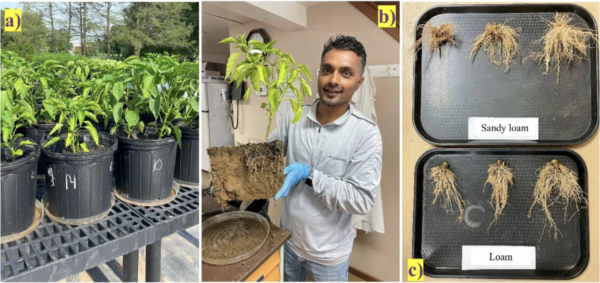
Biochar is widely used to improve crop productivity and soil health; however, its adoption remains limited due to insufficient quantification of benefits and unclear mechanisms, particularly within regenerative organic systems. We conducted a pot experiment applying biochar at 0 (control), 11.2, and 22.4 Mg ha⁻¹ to sandy loam and loam soils planted with sweet pepper (Capsicum annuum L.) and measured plant performance, microbial biomass, and soil organic carbon (SOC). Yield was higher in sandy loam than loam (282 vs. 146 g plant⁻¹). Biochar increased loam yield from <100 g plant⁻¹ (control) to ~240 g plant⁻¹ at 22.4 Mg ha⁻¹, while sandy loam yield plateaued beyond 11.2 Mg ha⁻¹. Microbial biomass was greater in sandy loam (6845 ng g⁻¹) than loam (3737 ng g⁻¹) and declined~17% at the highest rate, from 5628 to 4682 ng g⁻¹. Arbuscular mycorrhizal fungi colonization peaked at the moderate rate and declined at the highest rate. Although biochar increased SOC, SOC related weakly to microbial biomass in sandy loam and a significant negative relationship in loam (declining from ~4200 to 2800 ng g⁻¹ as SOC rose from 1.8 to 5.0%), indicating that biochar-derived carbon was not readily available to soil microorganisms. Fruit nutrient concentrations were unchanged across treatments. These results show biochar effects are soil- and rate-dependent: moderate application (11.2 Mg ha⁻¹) improved productivity without suppressing microbial biomass, whereas the highest rate (22.4 Mg ha⁻¹) further improved loam yield but reduced microbial biomass and decoupled SOC accumulation from microbial activity, without improving fruit nutritional quality.
Keywords: Biochar, Microbial biomass, Mycorrhizal fungi, Soil organic carbon, Sweet pepper
This material is based upon work supported by the Nutrition Science Foundation.