

Farmers and scientists are exploring the benefits of hemp for both regenerative organic farmers and consumers.
HEMP HAS BEEN MAKING an astonishing comeback. The crop was a highly valued agricultural resource for the first 150 years of American history; then it was banned for the next 70 years, until the 2014 US farm bill allowed farmers to plant it again. Now its growth is yielding a wide range of products that can support the health of people and the planet. Rodale Institute researchers are working with organic farmers to maximize its agricultural, medicinal, and economic value.
Scientists at the Rodale Institute Pocono Organic Center are studying how hemp can build soil health and yield products that benefit human health.
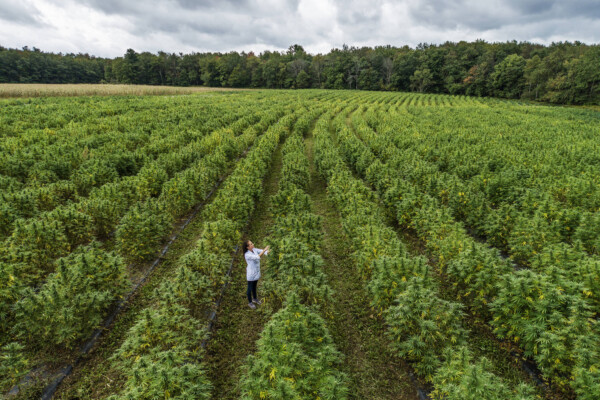
“The hemp research conducted at the Rodale Institute Pocono Organic Center has received global awareness for its reports on soil health, nitrogen management, cover cropping, and hemp’s weed suppression capabilities,” says Ashley Walsh, president and founder of Pocono Organics, a Long Pond, Pennsylvania, operation that produces certified organic CBD products with its own Regenerative Organic Certified hemp. “The ongoing research collaboration [between Rodale Institute and Pocono Organics] validates the benefits of our regenerative organic practices and helps us pioneer new approaches that benefit the entire organic hemp industry.”
Let’s begin with making an important distinction. Hemp has a complicated history because botanically it is Cannabis sativa—the same plant as the one known as “marijuana.” But they are different in significant ways. Tetrahydrocannabinol (THC) is the psychoactive component of marijuana, or the compound that triggers the sensation of euphoria. By law, hemp plants must have a THC concentration less than 0.3 percent, which is below the threshold that causes people to feel high.
Our bodies naturally produce endocannabinoids, enzymes that aid in managing sleep, mood, appetite, immune functions, and more by playing an active role in the communication between our nerve cells and brains. While hemp contains little or no THC, it produces other types of cannabinoids, such as cannabidiol, or CBD. Many people today use CBD products to relieve chronic pain, insomnia, and other conditions. CBD is extracted from the flowers of hemp plants and infused into tinctures, skin lotions, and other wellness products. “After being diagnosed with gastroparesis (a paralyzed stomach) in my late twenties and turning to plant-based medicine, including CBD, I experienced the transformative power of this remarkable plant firsthand,” Walsh says. Research report: Organic farmers can optimize the CBD content of hemp by carefully managing the amount of nitrogen fertilizer the crop gets, according to a study led by Dinesh Panday, PhD, a Rodale Institute soil scientist. The results of this study were published in 2025 in the scientific journal Agrosystems, Geosciences & Environment.
NUTRITIONAL BOOST
Hemp seeds are rich in vitamins E, D, and A and healthy fats with a high content of heart-protecting omega-3 and omega-6 fatty acids. The seeds also supply your body with polyphenols and terpenoids, nutrients that have antimicrobial, antioxidant, and anti-inflammatory properties. Hemp seeds can be eaten raw or roasted, and they are typically used whole or ground in salads, smoothies, and yogurt.
NATURAL FABRIC
For centuries, hemp was grown primarily as a raw material for rope, canvas, and other textile products. Hemp fiber has a similar texture to linen and can be woven into fabrics such as denim. It is stronger and more durable than cottonbut requires less space, water, and other inputs to grow.
Research report: Planting industrial hemp crops close together produces higher yields than when plants are spaced more widely, but allowing more room between rows encourages thicker stalks and stronger fibers, according to the results of a field study at the Rodale Institute Pocono Organic Center. “This trade-off [between productivity and better quality] gives farmers flexibility depending on their priorities,” the researchers note.
PLASTIC ALTERNATIVE
A group of scientists working with the Rodale Institute Pocono Organic Center have been developing a composite made with hemp stalks. It is strong yet flexible like plastic but is produced without fossil fuels and is compostable. The main ingredient is the plant matter left after CBD is extracted for products sold by Pocono Organics. “Our first generation of this material has been used in an injection molder to make bowls and cups,” explains Ronald Kander, PhD, who is leading the project’s team of materials engineers from Philadelphia’s Thomas Jefferson University.
SOIL HEALTH
Hemp’s deep root system supports a diverse population of microbes and mycorrhizal fungi, important indicators of soil vitality. Rodale Institute researchers also note that hemp roots draw heavy metals out of the soil, making the crop an option for bioremediation of contaminated sites.
Research report: Tissue mineral testing of hemp plants grown in research plots found that this crop had accumulated a significantly greater concentration of lead and cadmium compared to the concentration of these heavy metals that had accumulated in sorghum-Sudangrass, a cover crop often used by organic farmers, the Rodale research team reports.
WEED MANAGEMENT
The vigorous growth of hemp produces a dense, leafy canopy that keeps sunlight from reaching weed seeds in the soil and prevents them from sprouting. It is so effective that hemp may deplete the volume of weed seeds in the soil, the researchers say, making it a useful component of an organic crop rotation.
Research report: In a 2016 to 2020 field study at Rodale Institute, yields of soybeans and wheat increased—while weed pressure decreased—when these crops followed fiber hemp in rotation.
CASH CROP
The global industrial hemp market size is projected to grow from more than $11 billion in 2025 to nearly $48 billion by 2032, says Fortune Business Insights, a source of economic data. Farmers growing hemp for fiber can earn up to $1,220 per acre, and those growing it for seed can earn up to $550 per acre, according to data included in the 2023 Rodale Institute report Growing Industrial Hemp as an Organic Cash Crop.
“Hemp is a powerful plant ally for me as a regenerative organic farmer because it enriches the soil, supports biodiversity, and thrives without heavy inputs,” says Clarenda “Farmer Cee” Stanley, the 2025 Good Farmer Award US winner. (Meet her on page 30.) “As part of Green Heffa Farms’ healing herbs and products, it carries those same benefits forward—offering plant medicine that is both restorative to the land and to the people who use it.”
This story was originally published in the 2025 Rodale Institute Journal.