

Improving the Effectiveness of Cover Crop Rolling/Crimping for Weed Control and Soil Health: Advancing Industrial Hemp Research at Rodale Institute
Rodale Institute, a global leader in regenerative organic agriculture, is advancing new research to improve the effectiveness of cover crop rolling and crimping, a crucial practice for managing weeds and protecting soil in organic farming. Through a Northeast SARE–funded project (LNE23-473R), we are examining innovative rolling patterns to boost weed control, soil health, and crop productivity in organic sweet corn/ soybean and industrial hemp systems.
Why This Research Matters
Organic farmers across the Northeast face persistent challenges with weed management, the number one research priority identified by the Organic Farming Research Foundation. Without access to herbicides, many rely on tillage, which can damage soil structure and cause erosion. As more farmers turn to regenerative methods, there is an urgent need for effective, low input weed control strategies that protect soil health and reduce costs.
Cover crops like cereal rye, hairy vetch, and crimson clover are key tools in regenerative organic farming. When rolled or crimped properly, they form a mulch that blocks weeds, holds moisture, and enriches soil. But achieving consistent results is difficult. Uneven residue or cover crop “bounce-back” often allows weeds to return, forcing farmers to make extra passes with equipment.
Rodale Institute’s research directly targets this problem. Scientists are evaluating how different rolling and crimping patterns, especially, parallel, perpendicular, and angled to cover crop rows affect weed suppression, soil moisture, and crop establishment during the main season of cash crops. The goal is to refine this proven technique, so it works better, using no extra fuel or labor.
Industrial Hemp Research at Rodale Institute
Industrial hemp has been a cornerstone of Rodale Institute’s research since 2017. The Institute leads efforts to reintroduce hemp as a valuable crop for both farmers and the environment. Hemp provides fiber, grain, and plant-based materials while improving soil health and reducing weeds.
Early Rodale Institute’s study showed that adding hemp to organic crop rotations can cut weed density by up to 60% and reduce the weed seedbank by 25%, while strengthening soil structure and resilience.
“Industrial hemp offers tremendous potential as both an economic and ecological crop,” said Dr. Dinesh Panday, Industrial Hemp Researcher and Soil Scientist at Rodale Institute. “By combining hemp production with effective cover crop management, we’re helping farmers create regenerative systems that reduce inputs, improve soil health, and increase profitability in northeast region.”
The project is taking place at two Rodale Institute’s research sites, namely Kutztown, PA (USDA Zone 6a) and the Pocono Organic Center in Long Pond, PA (Zone 5b), allowing researchers to evaluate the system in different climates and soil types.
Project Goals and Deliverables
The project aims to (i) compare how three roller-crimping patterns affect weed suppression, (ii) measure how these patterns interact with cover crop species and influence yields of organic sweet corn and fiber hemp, and (iii) share the results with farmers through field days, training sessions, and educational materials.
Results will be shared through scientific papers, technical guides/ extension articles, webinars, newsletters, and Rodale Institute’s annual field days, which attract hundreds of visitors each year.
Field Activities in 2024–2026
Research plots in Kutztown and Pocono compare three cover crops (cereal rye, hairy vetch, and crimson clover) under the different rolling/crimping patterns. Cash crops include hemp and sweet corn in Kutztown, and hemp and soybean in Pocono. Scientists and research technicians are tracking crop establishment, soil moisture, weed pressure, and the release of natural plant compounds (allelochemicals) that suppress weeds.
Farmer participation is central to this project. Growers help collect data on weed suppression and yield, provide feedback, and test roller-crimper techniques on their own farms. A recent survey of participating farmers showed that while most use roller/crimping for weed and moisture control, many face challenges like uneven crop kill and limited access to equipment, underscoring the importance of this work.
Preliminary findings are already being shared at Rodale Institute’s Annual Field Day, specialized training, and outreach events, including the First Specialty Crop Symposium (2023) and Hemp Field Day at Pocono Organics (2025). A comprehensive result will be published once field studies conclude in both locations, supported by farmer-led demonstrations and outreach materials.
Toward a Regenerative Future
Rodale Institute’s work on rolling and crimping goes beyond academic research, as it is part of a larger effort to make organic and regenerative farming more practical, resilient, and profitable. By refining roller-crimper technology and integrating industrial hemp into diverse rotations, we aim to help farmers reduce costs, improve soil health, and strengthen local food systems. Through projects like this, we continue to lead the way toward a future where healthy soil, sustainable farming, and thriving rural economies grow together.
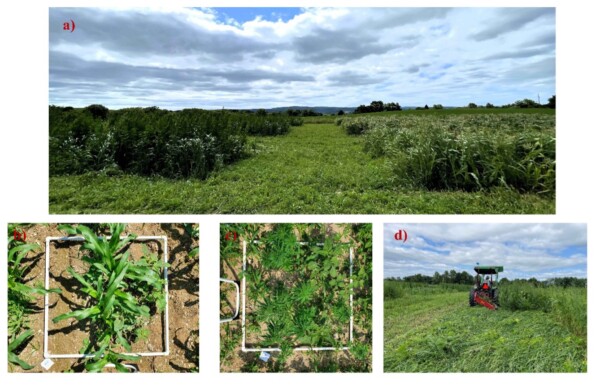
Figure 1. Field research activities at Kutztown site- a) standing industrial hemp and sweet corn, b) & c) weed data collection, and d) termination of hemp after data collection.