

FIBER HEMP IS GAINING BASE IN PENNSYLVANIA. As demand grows for sustainable textiles, biobased materials, and local supply chains, more Pennsylvania farmers are exploring hemp as a specialty crop. Producing consistently high-quality fiber hemp, particularly in cooler, higher-elevation areas depend on two key decisions that are often overlooked: when to plant and how to prepare the soil. Rodale Institute is now studying both.
Why It Matters
How well hemp establishes in spring depends heavily on soil conditions at planting. Soil temperature, moisture, and physical conditions all influence seedling emergence, early vigor, and how the crop performs through the season. Get those factors wrong, and the consequences show up at harvest such as poor plant stands, weak fiber, and lower returns for the farmer.
Cover crops offer a promising tool to improve those early-season conditions. Cereal rye provides reliable winter cover and strong weed suppression, but its dense residue can smother hemp seedlings if termination and incorporation are not carefully timed, a challenge more pronounced in cooler soils and shorter growing seasons. Hairy vetch, a legume, can contribute biologically fixed nitrogen and support soil biology, but it often performs inconsistently when planted alone in cold, heavy soils. A mixture of the two may offer the best of both.
Planting date adds another layer of complexity. Even slight shifts in timing can affect hemp canopy closure, biomass production, and fiber quality at harvest. For growers, where there is less room for error, science-based guidance on combining cover crops with the right planting schedule remains limited.
Rodale Institute has spent several years building foundational knowledge on industrial hemp in the Northeast, from nitrogen management and row spacing to variety performance and mechanical fiber quality testing. That body of work, highlighted in a 2025 feature in CSA News, showed that early-season soil conditions often shape hemp outcomes more than nutrient inputs alone. A 2026 study published in Crops & Soils further found that no-till systems incorporating cover crops and minimal nitrogen inputs consistently produced stronger, higher-quality fiber than conventionally tilled and heavily fertilized plots. This new project takes that work a logical step further.
What Rodale Institute is Doing
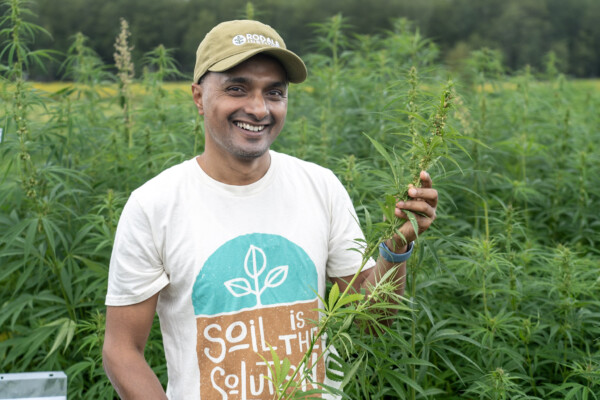
Starting in 2026, Rodale Institute will improve Pennsylvania fiber hemp production by identifying effective winter cover crop strategies and planting dates through on-farm trials comparing cereal rye, cereal rye–hairy vetch mixtures, and no-cover crop/ tilled fallow, and by disseminating practical recommendations to growers through field demonstrations and outreach activities.
The trial is running at Rodale Institute’s Main Campus in Kutztown, where the fiber hemp will be planted at two different times i.e., early (mid May) and late summer (early June) to identify the planting windows that best support crop establishment and fiber quality across the three cover crop treatments.
Over the two field seasons, researchers will monitor seedling emergence, plant height and biomass, weed pressure, and leaf nitrogen levels. We will also assess soil health using biological, chemical, and physical indicators, including microbial activity, organic matter, water-stable aggregates, and infiltration rate. At harvest, fiber yield and quality will be evaluated across all treatment combinations.
Who Benefits
This research is designed with Pennsylvania hemp growers in mind, particularly those seeking practical, regenerative approaches to improving fiber quality without heavier inputs. Results will be shared through field days at Kutztown, grower-focused fact sheets, an online seminar, conference presentations, and peer-reviewed publication. The project aims to reach approximately four hundred growers and stakeholders across Pennsylvania.
The Bottom Line
In practical terms, better cover crop management and well-timed planting can help Pennsylvania hemp farmers:
· establish stronger, more uniform crop stands;
· build healthier, more resilient soils;
· produce higher-quality fiber; and
· achieve more reliable results without relying on additional input.
By translating these findings into field-ready recommendations, the project will give growers practical, regenerative guidance they can apply with confidence.
—
This project is funded by the Commonwealth Specialty Crop Block Grant Program/ Pennsylvania Department of Agriculture.
Note:
BannerImage- Research field with cover crops: no cover crop, cereal rye–hairy vetch mix, and cereal rye alone (Image by Dinesh Panday)