

A Rodale Institute Perspective Incorporating Regenerative Organic Certified®
Abstract
Organic and regenerative agriculture are increasingly invoked in scientific, policy, and market contexts, yet their definitions remain inconsistently applied. This paper synthesizes Rodale Institute’s scientific and philosophical perspective on organic and regenerative organic agriculture, clarifying distinctions between regenerative practices and regenerative systems. Drawing on long-term field research and the Regenerative Organic Certified® (ROC) framework, the paper examines whether conventional agriculture can be regenerative, outlines Rodale Institute’s research philosophy, and describes the scientific foundations underlying organic and regenerative organic systems. We conclude that regenerative organic agriculture represents a distinct, evidence-based system rooted in certified organic principles, ecosystem regeneration, animal welfare, and social equity, and that ROC provides a rigorous, verifiable standard to operationalize this definition.
1. Introduction
The modern organic agriculture movement emerged in response to the rapid expansion of chemical-intensive agriculture during the twentieth century (Heckman 2006). Synthetic fertilizers, pesticides, and herbicides contributed to increased crop yields and reductions in hunger in some regions; however, their widespread use has also resulted in significant environmental and public health externalities (Tilman, Cassman et al. 2002). Globally, more than one-third of soils are now considered degraded, limiting agricultural productivity and ecosystem service provision (Gomiero 2016, FAO 2018). Agricultural chemicals contaminate surface and groundwater, contribute to greenhouse gas emissions, accelerate biodiversity loss, and bioaccumulate in ecosystems and human populations (Moyer, Smith et al. 2020).
More than seven billion pounds of active pesticide ingredients are applied annually worldwide (FAO 2024)(Pesticides use. July 2024 update), and overall pesticide use has increased steadily over the past two decades (Shattuck, Werner et al. 2023). Epidemiological research has identified associations between agrichemical exposure and elevated cancer incidence and other health outcomes in agricultural regions (Gerken, Vincent et al. 2024). These trends have prompted renewed interest in agricultural systems capable of sustaining productivity while restoring ecological function and protecting human health.
Organic and regenerative organic agriculture have been proposed as systems capable of sustaining agricultural productivity while restoring ecological function and protecting human health. Although often conflated in public discourse, these approaches differ in scope, intent, and verification. Regenerative organic agriculture builds upon organic foundations and extends them by explicitly prioritizing ecosystem regeneration, soil health and carbon restoration, animal welfare, and social equity. The principal source of confusion lies in the growing use of the term regenerative in isolation. Frequently applied to individual practices or conventional systems without clear standards or baseline requirements. This paper clarifies these distinctions from the perspective of Rodale Institute, a nonprofit research organization with more than four decades of long-term field research in organic systems.
2. Defining Organic Agriculture
Organic agriculture is a systems-based approach to food production that excludes synthetic fertilizers, pesticides, herbicides, genetically modified organisms (GMOs), and other prohibited inputs. Instead, organic systems rely on ecological processes, including crop rotation, cover cropping, composting, biological nutrient cycling, and soil and ecological biodiversity to maintain productivity and resilience.
From a scientific standpoint, organic agriculture is grounded in agroecology and systems ecology. It recognizes farms as complex adaptive systems in which soil, plants, microorganisms, animals, water, and climate interact dynamically. Resilience emerges from biological diversity rather than chemical substitution. Organic management emphasizes functional agrobiodiversity, which supports nutrient cycling, pest and disease suppression, soil structure, and long-term system stability.
Under U.S. and international regulatory frameworks, organic certification requires a transition period, typically three years, during which land must be managed without prohibited synthetic inputs. This transition reflects the time required for soil biological processes and ecosystem functions to recover from chemical dependency (USDA, 2023).
Rodale Institute further situates organic agriculture within the four principles articulated by the International Federation of Organic Agriculture Movements (IFOAM): Health, Ecology, Fairness, and Care. These principles assert that agriculture should sustain the health of soils, ecosystems, and people; work with ecological systems; ensure fairness and equity throughout the food system; and be managed responsibly for future generations (IFOAM, 2014).
Thus, organic agriculture is not defined solely by the absence of synthetic inputs, but by an intentional, systems-oriented commitment to ecological integrity and long-term sustainability.
3. Defining Regenerative Organic Agriculture
Regenerative organic agriculture represents an advanced approach to organic systems that goes beyond maintaining productivity to actively restoring ecological, climatic, and social systems. It integrates soil regeneration, ecosystem function, climate resilience, high animal welfare, and social equity across entire farming operations. This approach has been formalized through third-party programs such as the Regenerative Organic Certified® (ROC) framework—which aims to raise the integrity and outcomes of organic agriculture by embedding regeneration, transparency, and accountability into production systems—as well as The Real Organic Project (ROP).
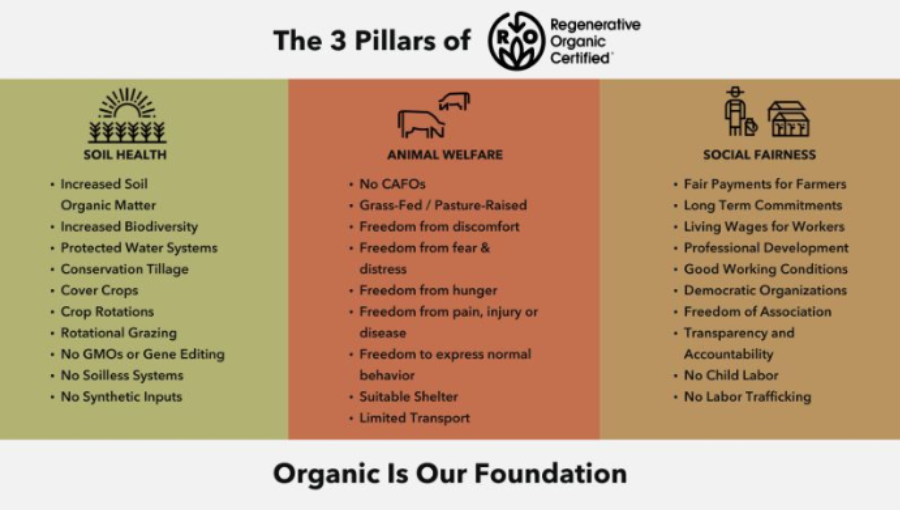
ROC builds upon certified organic requirements and evaluates compliance across three integrated pillars:
3.1 Soil Health and Land Management
This pillar requires continuous implementation of regenerative practices such as cover cropping, diversified rotations, compost application, and reduced or conservation tillage. The objective is to increase soil organic matter, improve soil structure, enhance biodiversity, and sequester atmospheric carbon. Soil-less production systems, including hydroponics, are excluded since improving soil health is an essential foundation of organic farming.
3.2 Animal Welfare
ROC requires livestock systems that support physical health, natural behaviors, and low-stress living conditions, aligned with internationally recognized animal welfare principles such as the Five Freedoms. Key requirements include access to pasture or rangeland, prohibition of concentrated animal feeding operations (CAFOs), limits on transport stress, and provision of appropriate nutrition, shelter, and veterinary care throughout the animal’s life cycle.
3.3 Farmer and Worker Fairness
This pillar integrates social sustainability as a core regenerative outcome. It requires fair compensation, safe and healthy working conditions, freedom of association, access to training and capacity building, and protections against forced or exploitative labor, including child labor. By embedding labor rights and human dignity into certification, ROC affirms that agriculture cannot be considered regenerative if it degrades livelihoods or relies on social inequity.
4. Can Conventional Agriculture Be Regenerative?
The question of whether conventional agriculture can be regenerative hinges on the distinction between regenerative practices and regenerative systems. Individual practices such as cover cropping, reduced tillage, compost application, and diversified crop rotations can improve soil structure, reduce erosion, enhance biological activity, and are beneficial across production systems (Moyer, Smith et al, 2020).
However, the adoption of discrete conservation practices does not, by itself, constitute regenerative agriculture. Continued reliance on synthetic pesticides, fertilizers, and genetically engineered crops has been linked to environmental contamination, biodiversity loss, and documented health risks to farmers, farm workers, and rural communities. These outcomes conflict with the regenerative goal of restoring ecological and human health.
Guided by the IFOAM principles, Rodale Institute maintains that regenerative agriculture must promote ecosystem regeneration, human health, social equity, economic viability for farmers, and high standards of livestock welfare. Farming systems that fall short of these principles should not be considered or labeled as regenerative.
To provide clarity and prevent misuse of the term “regenerative,” Rodale Institute—together with Patagonia and Dr. Bronner’s—co-developed the Regenerative Organic Certified® (ROC) standard. Under ROC, farms must meet USDA Organic or equivalent certification requirements before becoming eligible for regenerative organic certification (Regenerative Organic Alliance, 2023).
Accordingly, while conventional farms may adopt regenerative practices and improve ecological performance, only certified organic systems qualify as regenerative organic under the ROC framework.
5. Research Philosophy at Rodale Institute
Rodale Institute’s research philosophy is guided by the principle: Healthy Soil = Healthy Food = Healthy People. Since its founding in 1947, the Institute has emphasized long-term, field-scale experimentation to evaluate agricultural systems under real-world conditions. This work is grounded in transparent, repeatable study design, with results interpreted using established scientific methods to ensure rigor and impartiality.
The Farming Systems Trial (FST), initiated in 1981, compares conventional chemical-based grain systems with organic systems in replicated, side-by-side plots. Additional long-term experiments include the Vegetable Systems Trial (initiated in 2016) and the Diverse Systems Trial (initiated in 2024), which examines livestock integration within diversified organic rotations.
Findings across these trials demonstrate that, after an initial transition period, organic systems can achieve yields comparable to conventional systems and often outperform them under climatic stress such as drought. Organic systems also build greater soil organic matter, sequester more carbon, reduce non-renewable energy use, emit fewer greenhouse gases, and minimize chemical runoff and leaching (Moyer, Smith et al, 2020).
6. Scientific Foundations of Organic and Regenerative Organic Agriculture
Organic and regenerative organic agriculture are grounded in overlapping but distinct bodies of scientific research spanning soil science, agroecology, climate science, and social–ecological systems. Together, these disciplines provide the empirical basis for understanding how agricultural systems can sustain productivity while restoring ecological and human health.
Organic and regenerative organic systems draw on multiple scientific disciplines:
- Soil science and microbiology, emphasizing soil as a living ecosystem that drives fertility, water retention, and carbon storage.
- Agroecology and systems agronomy, framing farms as integrated ecosystems rather than input-output production units.
- Climate science and biogeochemistry, documenting the potential of regenerative organic practices to sequester carbon and mitigate greenhouse gas emissions.
- Social and ethical systems science, incorporating labor economics, animal welfare science, and rural sociology into sustainability assessment.
Together, these scientific domains support a systems-based understanding of organic and regenerative organic agriculture. Certification frameworks such as Regenerative Organic Certified® and the Real Organic Project represent structured efforts to translate this science into verifiable practices and market-facing standards, but the underlying evidence base extends well beyond any single program.
7. Conclusion
Contemporary debates about agricultural sustainability increasingly rely on terms such as organic and regenerative, yet inconsistent usage has obscured their scientific and operational meaning. This paper has examined how these terms function within ecological, agronomic, and social systems research, highlighting the importance of distinguishing between management practices, production systems, and verified standards when evaluating agricultural outcomes.
Drawing on long-term field experiments and systems-based research, the analysis underscores that agricultural regeneration is not the result of isolated interventions but of integrated management approaches that operate across soil, ecosystem, and human dimensions. Approaches grounded in organic principles provide structural conditions for such integration, while regenerative organic frameworks articulate how restoration-oriented goals can be embedded within whole-farm systems.
Drawing on more than four decades of long-term field research, Rodale Institute’s work demonstrates that organic systems can sustain productivity, enhance resilience, improve soil health, and reduce environmental externalities. Regenerative organic approaches extend these outcomes by intentionally focusing on restoration and continuous improvement across ecological and social dimensions.
As agriculture confronts accelerating soil degradation, climate change, biodiversity loss, and social inequity, clarity in definitions and standards becomes increasingly important. Organic and regenerative organic agriculture, grounded in ecological science and long-term systems research, offers coherent pathways for restoring agricultural landscapes while sustaining food production and rural livelihoods.
References
FAO (2024). Pesticide use and trade – 1990-2022. FAOSTAT Analytical Briefs, No.89. Rome, FAO. 89.
FAO, F. (2018). The future of food and agriculture—Alternative pathways to 2050, Food and Agriculture Organization of the United Nations Rome.
Gerken, J., G. T. Vincent, D. Zapata, I. G. Barron and I. Zapata (2024). “Comprehensive assessment of pesticide use patterns and increased cancer risk.” Frontiers in Cancer Control and Society 2: 1368086.
Gomiero, T. (2016). “Soil degradation, land scarcity and food security: Reviewing a complex challenge.” Sustainability 8(3): 281.
Heckman, J. (2006). “A history of organic farming: Transitions from Sir Albert Howard’s War in the Soil to USDA National Organic Program.” Renewable Agriculture and Food Systems 21(3): 143-150.
IFOAM. (2014). The Four Principles of Organic Agriculture. International Federation of Organic Agriculture Movements.
Moyer, J., Smith, A., Rui, Y., & Hayden, J. (2020). Regenerative Agriculture and the Soil Carbon Solution [White Paper].
Regenerative Organic Alliance. (2023). Regenerative Organic Certified® Framework. Retrieved from https://regenorganic.org/wp-content/uploads/2023/03/Regenerative-Organic-Certified-Framework.pdf.
Shattuck, A., M. Werner, F. Mempel, Z. Dunivin and R. Galt (2023). “Global pesticide use and trade database (GloPUT): New estimates show pesticide use trends in low-income countries substantially underestimated.” Global Environmental Change 81: 102693.
Tilman, D., K. G. Cassman, P. A. Matson, R. Naylor and S. Polasky (2002). “Agricultural sustainability and intensive production practices.” Nature 418: 671.
U.S. Department of Agriculture (USDA). (2023). National Organic Program Regulations. 7 CFR Part 205.