

Dinesh Panday a 1 2, Parinaz Heydar b 1, Casey Lapham a, Alyssa Pierce b, Madhav Dhakal c, Arash Ghalehgolabbehbahani a, Gabriella Fioravanti b, Ronald Kander b
aRodale Institute, Kutztown, Pennsylvania, USA
bKanbar College of Design, Engineering and Commerce, Thomas Jefferson University, Philadelphia, Pennsylvania, USA
cMississippi Water Resource Research Institute, Mississippi State University, Starkville, Mississippi, USA
Correspondence: Dinesh Panday, dinesh.panday@rodaleinstitute.org; dinesh.livingsoil@gmail.com
Abstract
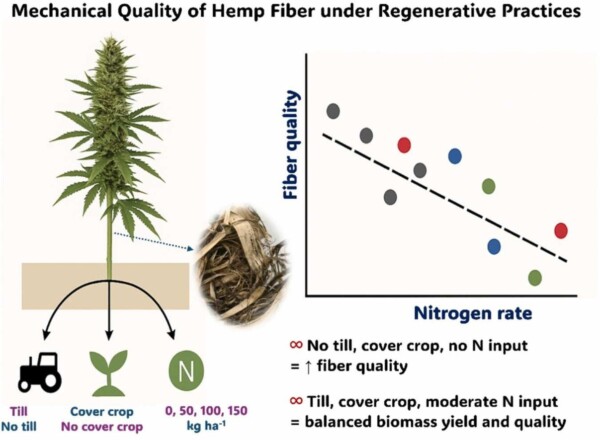
Industrial hemp (Cannabis sativa L.) is an emerging crop for renewable fiber materials. For farmers, finding a balance between agronomic performance and economic return is crucial, especially when targeting specific markets like the textile industry, which values not just fiber quantity, but overall quality. This field study, conducted at the Rodale Institute in Kutztown, Pennsylvania, assessed the effects of tillage (till vs. no till), cover crop (with cover vs. no cover), and nitrogen (N) rate (0, 50, 100, 150 kg ha⁻¹) on hemp fiber yield, N concentrations in leaf and stalk, and mechanical performance under regenerative organic conditions. Fiber mechanical properties, including maximum load, tenacity, work of rupture, and modulus of elasticity were analyzed at Thomas Jefferson University. Results showed that biomass yield increased with N input, peaking at 9.2 Mg ha⁻¹ under till systems with cover crop at 150 kg N ha⁻¹ . However, fiber quality declined at higher N rates. The highest fiber quality metrics, including tenacity (610.5 MPa), modulus of elasticity (3.5 GPa), and work of rupture (31.4 newton mm⁻²) was achieved in no till system with cover crops and no N addition. A clear trade-off emerged: high N increased biomass yield but compromised fiber quality, while moderate input levels (e.g., till system with cover crop at 50 kg N ha⁻¹) offered a balanced outcome. This suggests that regenerative practices not only support soil health but also improve fiber strength and flexibility. Farmers can tailor input strategies to match end-use goals: low-input systems for premium textile fibers and moderate inputs for bio-composite applications, supporting both ecologically sound and market demands.
Graphical Abstract
Keywords
Bio-composites, Industrial Hemp, Mechanical Properties, Natural Fibers, Regenerative Organic Systems