Healthy soil is the foundation of regenerative organic agriculture. But soil covers less than one-third of our blue planet. Water fills most of the world’s surface area. Like soil, it provides essential nourishment and a livelihood for people around the world.
Now, Rodale Institute has formed a research partnership with GreenWave, an organization focused on regenerative aquaculture, to explore how ocean-based food production can provide valuable resources to land farmers.
Before modern humans began cultivating crops, they were gathering food from the water. Today, American consumers, on average, eat about 20 pounds of fish and shellfish each year, according to a 2024 report from the USDA Economic Research Service. Seafood cultivation isn’t new, but it has scaled up dramatically in recent decades, with more than 50 percent of the global supply now raised on water-based farms, says the National Oceanic and Atmospheric Administration.
As the world’s population grows, “our food system is being pushed out to sea,” says Bren Smith, GreenWave’s cofounder and co–executive director. “We’re going to be eating more food from the sea, and the wild supply will not support us. With Rodale Institute, we are building a healthier food supply and connecting land and ocean farmers through regenerative practices.”
GreenWave trains aquafarmers to produce kelp and shellfish, such as oysters, using methods that protect the natural environment.
Thimble Island, Oysters, Bren Smith
Water Ways
Overfishing, habitat loss, climate change, and other factors have been reducing the stocks of wild fish and seafood for decades. When fishing became an unsustainable way of life for Smith in the 1990s, he “went into finfish aquaculture with the idea that ‘blue’ jobs were putting people back to work,” says the native of Newfoundland, Canada, who fished the Georges Bank and Grand Banks areas for tuna and lobster starting at age 14. “I soon saw that all the mistakes that have been made in farming on land were being repeated in the sea.”
Commercial aquaculture has in many ways become as resource intensive and environmentally detrimental as industrial land-farm production, with the excessive application of artificial nutrients, pesticides, and antibiotics; the degradation of the water and the surrounding landscape; and the disruption of theecosystems that sustain life. Smith imagined a different way of raising seafood. “I thought we should grow seaweed and shellfish—crops that don’t swim away and that can feed on the nutrients that already exist in the water,” he says.
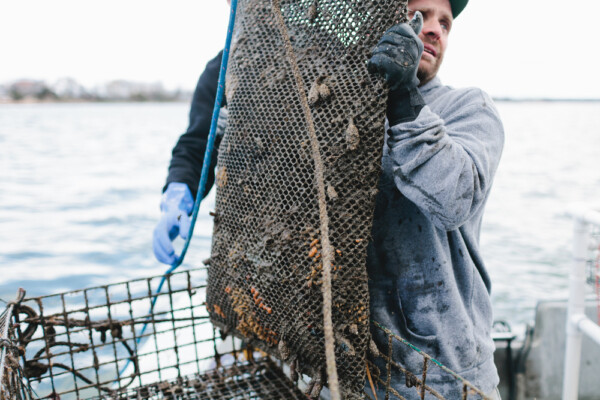
The GreenWave model for a vertical underwater farm has hurricane-proof anchors on the edges and floating horizontal ropes across the water’s surface. “If you look for our farms from the shore, there’s almost nothing to see,” Smith says. “They have very small footprints.” Kelp and other types of seaweed grow downward from the ropes next to scallops in hanging nets and mussels held in suspension in mesh socks. At the base are oysters in cages and clams in the sand. These types of shellfish are all filter feeders that consume microorganisms, primarily phytoplankton and algae that are naturally abundant in the water.
The farms produce two cash crops: high-protein shellfish and mineral-rich kelp. “We grow incredible amounts of food in small areas, raising 250,000 shellfish and 25 tons of greens per acre every five months,” he says. “This is zeroinput food that requires no fresh water, no fertilizer, no feed, and no land.”
GreenWave offers farmers a tool kit to set up their own regenerative ocean farming operations. “We want to help create farmer-owned and farmer-run co-ops in communities where fishing is a way of life,” Smith explains. Through the organization’s open-source model of sharing information, “anybody with 20 acres, a boat, and $30,000” can find the knowledge they need to get started. Since launching its first regional training program in 2017, GreenWave has educated and supported more than 8,500 ocean farmers, nursery operators, and entrepreneurs. “We’re no longer pillagers hunting the last fish,” he says. “We are a new generation of climate farmers who have joined the fight to restore our planet.”
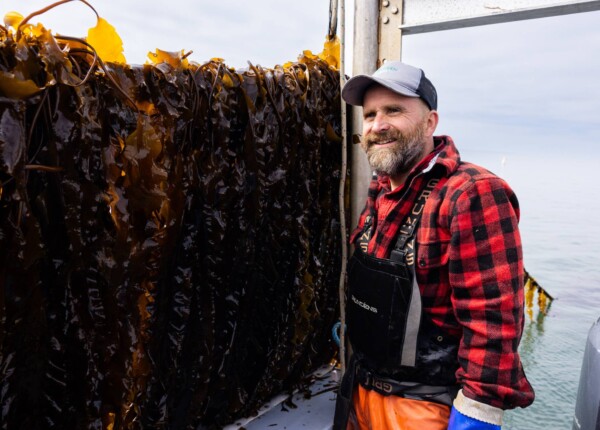
Bren Smith (above) is a former fisherman who has developed a model for sustainable, profitable aquaculture that yields abundant crops of mussels.
SOIL CONNECTION
Seaweeds such as kelp play a key role in aquaculture by absorbing carbon dioxide from the water and releasing oxygen that is essential for sea creatures. This process helps to balance the water’s acidity (which is increasing due to rising global temperatures) and in turn ensures that the bivalves can form healthy, protective shells. The shellfish filter the water, allowing more sunlight to reach the kelp, which stimulates growth.
Land-based farmers and gardeners living near bodies of water have long used seaweed as a soil amendment. “Whenever coastal communities needed nutrients for their crops, they’ve gone to the sea—that is, until fossil-fuel fertilizers came along,” Smith says.
Those synthetic fertilizers don’t build healthy soil, so organic land farmers don’t use them. Natural resources like kelp can provide vital nutrients to crops while supporting the soil’s overall health. “We have long known that products harvested from the sea have the power to promote plant growth and plant health,” says Andrew Smith, PhD, Rodale Institute’s chief scientific officer. Kelp acts as a “biostimulant” that activates the beneficial microbes in soil, improves nutrient uptake by crops, and protects plants from stress such as drought.
To learn more about the value of seaweed for organic farmers and consumers, the scientists at Rodale Institute are evaluating kelp biostimulant in real-world conditions. The researchers are conducting a two-year field trial and a one-year greenhouse experiment to test how GreenWave’s kelp biostimulant impacts the nutritional content of lettuce and bell pepper crops and contributes to soil health. It is being compared to biochar, a widely used organic soil amendment. The kelp will be applied at different rates in separate plots and used in combination with biochar in other plots.
“Kelp has many trace minerals that support healthy plant growth,” says Dinesh Panday, PhD, the soil scientist leading the research project. “We are studying its value for specialty crops in regenerative organic systems.” Panday expects results to be released in 2027.
“We need credible science to evaluate kelp’s benefits and find out how to get the most from it,” says GreenWave’s Smith. “We knew we had to have a technically sophisticated partner to dig deep into this. When we were meeting with the research team at Rodale Institute, I knew we were talking farmer to farmer, that we are working toward the same goals.”
In a regenerative food system, producers on land and sea share and protect the natural resources we all depend on. While GreenWave is implementing a new vision for ocean agriculture, Rodale Institute is supporting the next generation of soil-based organic farmers. “We’re both seeking sustainable solutions to improve the health and wellbeing of people and the planet,” says Smith of Rodale Institute.
Healthiest Catch
Fish and other types of seafood are smart choices when you want to eat healthy meals. They’re loaded with protein and low in saturated fats and calories. With all the varieties available, you may be wondering which are good for you and the environment. The Monterey Bay Aquarium Seafood Watch program has published a “Super Green List” of items that are nutrient dense for people and can be harvested with little or no impact on the ecosystem. The top 10 items include foods produced by the GreenWave farming model: mussels, clams, oysters, and kelp. When seafood is in your dinner plans, go for these options and eat well while protecting our blue planet.