our work
Soil Health
Current Projects
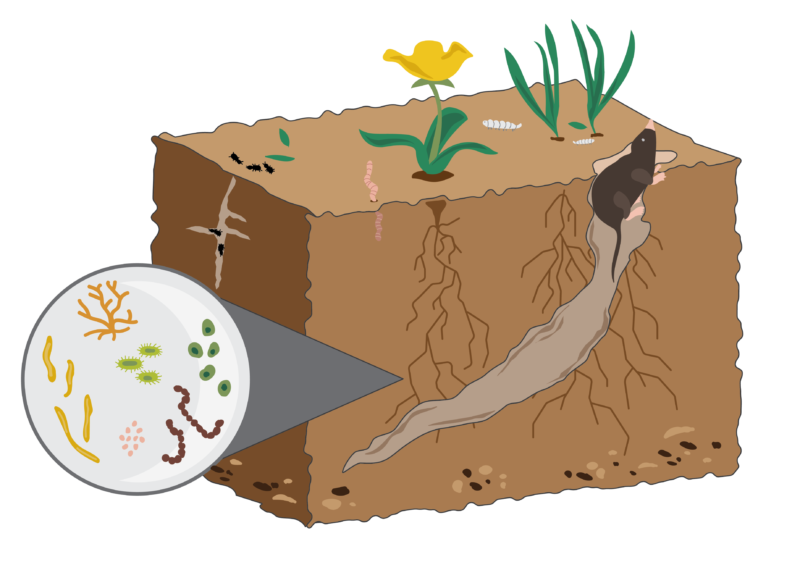
We have a number of projects focused on different aspects of living systems including increasing organic matter, balancing the soil food web, building available nitrogen and sequestering carbon. Our end goal is to increase growers’ familiarity and comfort with organic soil health concepts and techniques, clarify their true ecological and financial benefits, and encourage their adoption on both organic and conventional farms across the country.
Demonstration of Improved Compost Management to Effectively Utilize Animal Waste Nutrient Resources and Support Increased Soil Nutrient Retention (CIG Compost)
Rodale Institute, in collaboration with neighboring EQIP-eligible farmer James Burkholder and the local municipality of South Whitehall Township, has initiated a comparative composting demonstration, using uniform base materials (high-quality pelletized chicken manure, food waste, and municipal leaves) to illustrate the impacts of different compost pile management regimes on final compost quality, nutrient content, and nutrient retention, as well as on field soil quality and nutrient leaching after application. Two different compost management regimes (1: timed turning, based on National Organic Program (NOP) standards; and 2: temperature-related turning) will be demonstrated atop compost production pads fitted with drains to capture all precipitation and leachate that runs through each pile.
Nutrient Management in Organic No-Till Systems (CIG Nutrient Management)
Rodale Institute, the USDA Agricultural Research Service (ARS) Beltsville Agricultural Research Center (BARC), and North Carolina State University (NCSU) are collaborating on a demonstration and outreach project to integrate current reduced-tillage organic corn production practices with pre-existing corn planter fertilizer delivery technology. The goals of this work are to 1) optimize the use of animal waste products as fertilizers in sustainable and organic corn no-till production, 2) improve retention of animal-based crop nutrients by reducing volatilization and run-off into waterways, and 3) reduce farmers’ labor and input costs to increase their economic returns.
Rapid, Cost-effective Soil Measurements for Accurate Agricultural Carbon Crediting (CIG Soil Carbon)
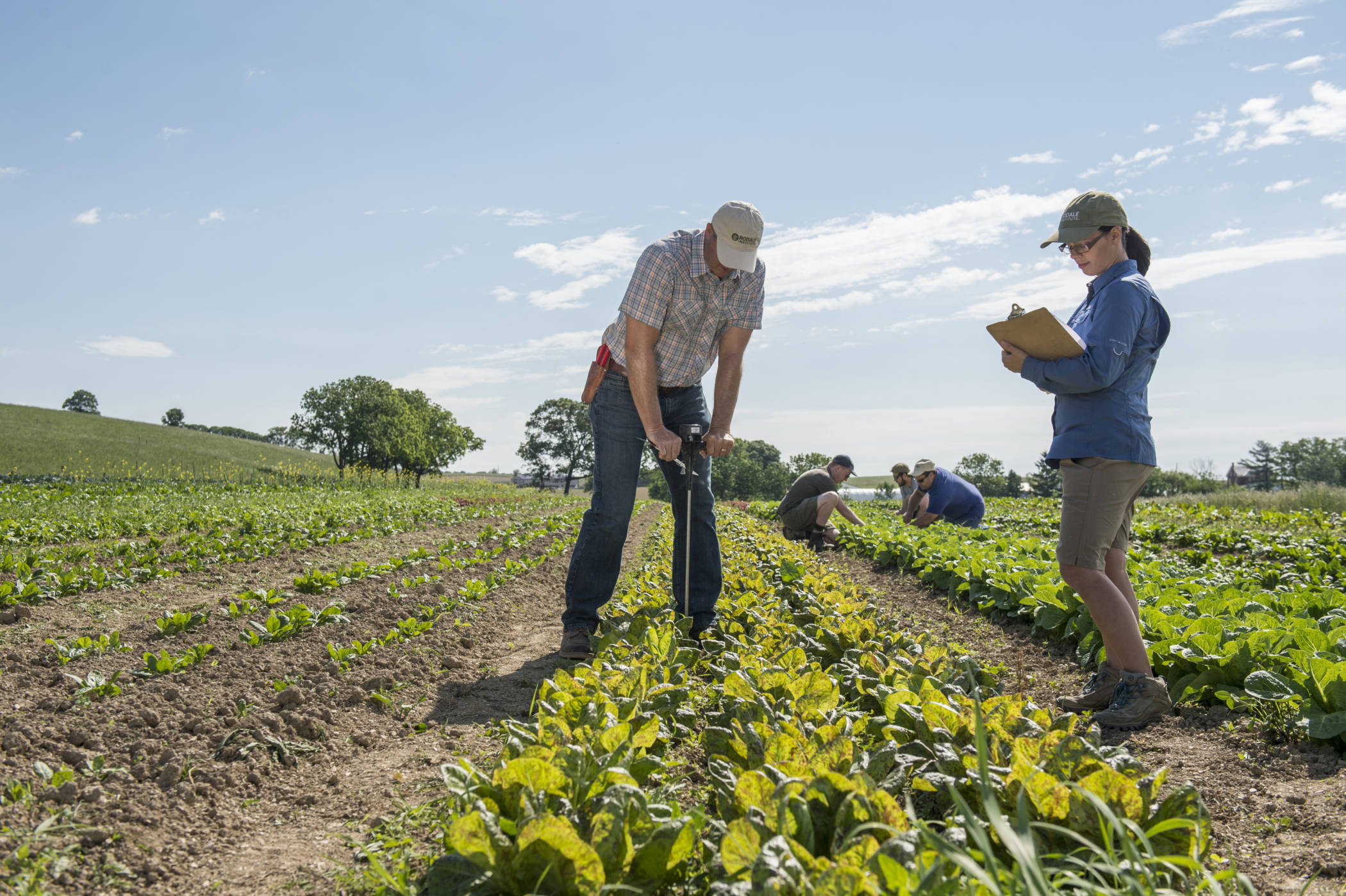
The primary purpose of this soil carbon assessment project is to allow early monitoring and assessment of changes in soil carbon using a scalable Mobile Field Lab. Rodale Institute researchers are refining and demonstrating an inexpensive, innovative mobile field method to measure soil carbon content and changes. The goal of the work is to improve predictions for soil carbon changes on organic and conventional farms that utilize different soil management practices, providing a method of direct validation of soil carbon sequestration for crediting purposes.
Farming Systems Trial
The Farming Systems Trial began in 1981 as a 5-year controlled study of what a typical American grain farmer would go through to give up chemical fertilizers and pesticides, and it has matured into a complex, interdisciplinary, collaborative project. The Farming Systems Trial (FST) has provided fundamental research data on topics ranging from drought-tolerance to yield potential to water quality to economic viability, and has inspired similar long-term trials at research institutions nationally and internationally.
The trial is a 12-acre, 72 plot trial that currently compares four replications of six farming systems. The farming systems vary in their crop rotations, inputs and tillage practices. The goal of FST is to demonstrate sustainable, consistent yields in the organic systems while building ecosystem services.
So far, FST has demonstrated that, compared to conventional farming systems, organic systems can:
• produce competitive crop yields,
• improve soil and water quality,
• reduce crop damage in drought years, and
• sequester more carbon in the soil.
Hydroponics and Aquaponics Demonstration Project
Many commercial hydroponics producers believe that hydroponics cannot be done organically. Typical commercial greenhouse hydroponic systems use large amounts of high-salt inorganic fertilizers creating nutrient concentrations that cause disease organisms to flourish in the water. As a result, the high-concentration nutrient water needs to be flushed quite often, causing overloads in local sewage treatment systems, streams, rivers and lakes.
However, natural wetland systems are able to make nutrients available to plants in a completely balanced, healthy way, and hydroponic and aquaponic systems can be redesigned to mimic those natural processes. Weekly applications of compost extract will introduce into these systems the sets of organisms, along with humic and fulvic acids, required for optimal nutrient cycling to maintain healthy plant growth.
Please make arrangements in advance to view our hydroponics and aquaponics demonstration projects by calling 610-683-1400.
Developing carbon-positive organic systems through reduced tillage and cover crop-intensive rotation schemes (Integrated Organic Program)
This project, funded by the USDA Organic Research and Education Initiative (OREI) Program through Iowa State University, includes the coordinated evaluation of four reduced tillage, organic grain crop rotation sequences through field trials implemented at Rodale Institute and an organic farm in Dauphin County, PA, as well as at research stations and on farms in North Dakota, Minnesota, Wisconsin, Iowa and Michigan.
Integrated Livestock-Crop Rotation Management to Maximize Carbon Sequestration and Economic Returns
This project will allow researchers to quantify the ability of integrated crop and livestock systems to increase soil health and carbon sequestration, reduce dependence on fossil-fuel-based inputs, and improve economic returns for farmers, relative to cash grain systems. This joint effort between the Rodale Institute and the USDA Agricultural Research Service (ARS) will have significant economic and conservation implications for the forage, crop, and pasturelands of the U.S and will provide new information on carbon sequestration from these lands.
Arbuscular Mycorrhizal Fungi and their Roles in the Enhancement of Crop Growth and Soil Quality
This 20-year collaboration with USDA Agricultural Research Service (ARS), Microbiologist Dr. Dave Douds explores the benefits of using arbuscular mycorrhizal (AM) fungi in crop production, using both indigenous fungi present in the soil as well as mycorrhiza inoculum produced using on-farm technology. The work is divided into two types of experiments: 1) optimizing greenhouse culture regimes to produce vegetable seedlings that are well colonized by arbuscular mycorrhizal (AM) fungi and are of sufficient size and vigor for outplanting, and 2) monitoring the growth and yield of AM fungus inoculated vs. uninoculated vegetable seedlings grown to maturity under field conditions.
Project outcomes include development of organic greenhouse inoculum medium that enables farmers to easily and economically integrate mycorrhiza inoculum into their existing practices, along with management guidelines for propagation of native mycorrhiza populations.
PATH to Organic Soil Sampling and Analysis to Determine Carbon Sequestration on Organic Farms in the Path to Organic Program
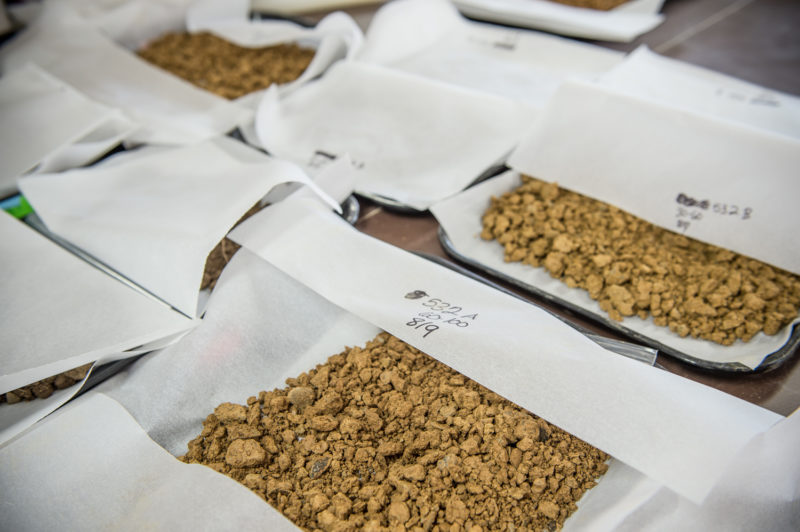
The purpose of this project is to conduct soil sampling to collect and analyze data to determine carbon sequestration in the soil on nine farms in the Path to Organic Program. The Path to Organic Program provides grants to farmers switching to certified organic production practices, evaluating those practices as tools to improve soil health, protect water quality, and gather atmospheric carbon on a pilot basis outside of the traditional research environment. The goal of the Path program is to: 1) provide an incentive for farmers to make the transition to certified organic production practices; and 2) evaluate organic production practices as tools in improving soil health, protecting water quality and sequestering atmospheric carbon on a pilot basis outside of the traditional research environment. The Path program provides grant payments of up to $7,500 in a single calendar year or $30,000 in a four-year period to reimburse participants for costs directly related to organic transition, including building, machinery and equipment, and operational costs.
Reducing Plastic Mulch Use by Expanding Adoption of Cover crop-based no-till Systems for Vegetable Producers (SARE Veggie)
The Northeast Sustainable Agriculture Research and Education (NE SARE) Program provided funding in 2010 to launch a three-year vegetable trial focusing on cover crop alternatives to petroleum-derived disposable black plastic mulch. The vegetable trials compare weed-suppression, yields and soil effects of rolled or mowed vetch and rye cover crops against the commonly-used black plastic mulch. Rodale Institute works with three collaborating farmers in Pennsylvania and New Jersey to trial a variety of cover crops in conjunction with four methods of cover crop termination (including plowing and covering with black plastic) to assess the comparative ability of these treatments to suppress weeds and disease and to contribute fertility in organic and non-organic vegetable crop rotations. A field experiment of the systems has also been implemented at Rodale Institute. Best management practices, based on this research, are being outreached to other farmers and the public.
Shumei Natural Agriculture Soil Research
The Shumei Natural Agriculture (NA) Gardens have specific approaches to growing crops and gardens that are similar to organic, but with some key differences. One difference is that Shumei NA does not use rotation to manage diseases or other pests. The RI research team is investigating the reasons behind the reduction and eventual disappearance of disease and insect pests in a system that does not use rotations. So far, the reason appears to be the development of an ever-improving set of soil organisms to combat, inhibit and out-compete the disease and pest organisms, particularly when the soil is only minimally disturbed.
Turf Management
The use of proper compost tea to enhance nutrient cycling and disease suppression without the use of inorganic fertilizer or pesticides was compared to standard inorganic fertilizer/pesticide management practices for the growth of turf grass in engineered soil. Three applications of compost tea and MAX™ Lawn Fertilizer were applied over a three month period and “walking paths” were introduced to the beds to create compaction representative of standard recreational use. The amount of observable dormant grass was much higher on the fertilized beds than in the compost tea beds and root biomass in the compost tea beds was four times higher than that the inorganic fertilizer treatment. More studies are being designed to continue to assess exactly how and why biological management works, and how to make it easy and practical for the home owner and small gardener.
Reduced-Tillage Weed Management for Organic Farming Systems (SASL)
Research is being performed to develop improved agronomic approaches for terminating cover crops, establishing cash crops and suppressing weeds in organic no-till soybean production systems. The two primary focuses of these experiments are:
• Soybean Establishment: How and when to roll rye cover crops and plant organic no-till soybeans.
• Soybean Supplemental Management: How and when to manage weeds after planting in organic no-till soybeans.